COMPASSIPEDIA
The OnlineCompass Museum


WE NEED YOUR HELP!
If you would like to be sure that this museum still exists on your next visit, please make a small DONATION.
Many thanks in advance.
 For the
complete company's history see WIKIPEDIA.
For the
complete company's history see WIKIPEDIA. Retailer of camping gear, see logo at right.
 Model
for non-commissioned officers* * Missing parts: drawing
Click on the images for enlarged views |
 Technical Data (rear side) - Ruler: 1 in / 25 mm - Transit lock (lever in a recess) |
Technical
Data - Dia.: 2" (50 mm), Thickness: ½ inch / 12mm, two fine black lines on the glass - Divisions: every 15 deg., only cardinals in Russian. The symbol for north on the right in the picture is not the letter C for CEBEP (pronounce 'siever') as usual but a triangle. - Case material: aluminum and brass - Sighting aids (missing on the item at left and only partly on the item below) see descr. at r. and patent below. The descr. below was published in the list of approved materiels (1907):  The models for non-commissioned officers (photo at left) and officers** (below) are described in the handbook of 1907. ** In modern Russian: нижние чины и офицеры (lien vers la page manuel) |
Sights:
The triangle's tip (see
pic below and pat. fig. 3, pos. 11a) is the fore sight and
the tiny notch in the loop (10 a') is the rear sight.
A serrated clamping disc (14) serves to lock the bezel on the
marching course angle value. |
Model
for officers The enlarged
picture represents a view of the compass completed as shown in the
drawings at right
|
 The engraved words on the back read: "Patent pending for Russia, Germany and England". Photographs by courtesy of Andrew X. |
Pic. at right: The joint initials АБ
(AB) of the designers Adrianoff and Bernstein are engraved on the
triangular loop's tip (fore sight) Below at left: drawing in Official 1907 User instructions. This version features a bar of luminous paint Below at center: Adrianoff's and Bernstein's patent, British issue (Complete version can be ordered) Below at right: Fig. 17 in the 1911 User Instruction booklet 


|
 |
|
This compass was possibly also a wrist compass,
but we
have never seen any with its original strap. It was the forerunner of
the famous Red Army soldiers' wrist compass.
|
Red Army
Training Manual (Click on image for full descr. in Russian)  |
This type of
compass type was
awarded to the laureates of the officers shooting school. Engraving on
reverse (ancient Russian): Captain Adrianoff's compass Captain Adrianoff's compassImproved version 1911 by the Officers of the Shooting School 1 division = 3 degrees i.e. 5 Mils |
 On the 1915 version, the name KRAUSS was added in the last line. |
Items built later
featured a simpler design. |
|
 |
View
dismantled: Magnetic
needle identical to patent. The crystal can be easily removed (3
screws) contrary to the Norwegian version. |
Norwegian
version: for technical data go to BUSCH
(no. 3350). The bezel was secured by means of a copper
wire (link to pic.). |


Landeslieferungs-Genossenschaft für das Feinmechaniker-Handwerk Sachsen GmbH Dresden
(No further information available up to now. Thank you for helping us)

The
two lid versions
(Pict. at left courtesy zonamilitar.com.ar) |
 Click on the images for enlarged views |
Technical
Data See detailled description in PLAN Ltd. - Dia.: 54 mm ; thickness : 18 mm - Divisions: 360° - Markings: B. N° 10816 (Brújula Número = compass number) - Luminous markings: no Radium contrary to C. & E. and PLAN Ltd. |
 PROFILE
- ASKANIA is a German company (Askaniawerke AG). For
more information click HERE
(see also in the section AERONAUTICAL COMPASSES, BAMBERG / Friedenau
and also
ASKANIA in WRIST and in SURVEY compasses).
PROFILE
- ASKANIA is a German company (Askaniawerke AG). For
more information click HERE
(see also in the section AERONAUTICAL COMPASSES, BAMBERG / Friedenau
and also
ASKANIA in WRIST and in SURVEY compasses).
(Click
on the pictures for enlarged views)  |
This
compass
bears the logo made of three triangles representing the three
upper-case letters "A" of the company's name "AskAniA" (right).
The shape of each of the three "A"s reminds of masonic symbols. In
the lid is the plant's name BODENSEEWERK (Lake Constance facilities)
engraved. The NSN (6605-12-120-1506 at left) is also impressed on the leather pouch  Description in the soldier's handbook (Soldatenhandbuch) of the Bundeswehr |
The
company's
name with three upper-case "A" (AskAniA) on a Dutch Army compass.
Placed above an elongated oval, it looks like a crown.
(Click on picture for enlarged view) Picture Ted Brink / LINKS, Military compasses Technical Data - Dimensions (folded): 70 x 70 x 18 mm - Weight: 140 gr - Ruler: 100 mm - Divisions (Germany): 6400 mils - East-West stripe like on the Bézard compasses. On Warsaw Pact compasses (see FPM), this stripe is always oriented along the North-South axis. |
 |
Belgium's
Army (ABL = Armée
Belge / Belgisch Leger) also used
compasses made after Askania's name
was changed to BODAN.
On one face, there is a logo with the letters W and V inside a
circle
above the German city name of BIELEFELD where there probably was a
plant.
 |
A
very similar
model was already in use during the late 1940's/early
50's in Belgium's and The Netherlands' armies. Their version featured a
double graduation: degrees plus mils. |
 |
  |
Export
models like this item issued
to Peru's Army troops
featured cardinals matching all Roman languages
(O = Oeste / E = Este). The
case was sand-colour painted and not NATO green.
There were no rubber pads on the external faces. The mirror's
rear face was painted grey. Inscriptions: - In the lid, only the word GERMANY - Outer face: Logo and serial /no. The leather pouch was black and rectangular. |
 |
 |
 The value of the magnetic deviation at this time (9 degrees West) was taken into account by glueing the paper pointer onto the magnetised metal plate askew by this angle. The paper arrow and the frame under the crystal were covered with a luminescent paint |
Technical
Data - Diameter: 46 mm - Weight: 35 g Materials: - case: wood - lid: aluminium - bezel: nickel (?) |
| Advertisement
(1915) found in the VONIN
papers (Click on picture for enlarged view)  |
The box' lid with the
flags of the allied countries
(before the U.S. declared the war to Germany): France, Great-Britain,
Belgium, Holland, Luxemburg and Russia |
User's
Instructions (copies can be ordered)  (Click to view page 2) |
(...) |
 (Click on the pictures for enlarged views) This item features cardinal points in German language (N-O-S-W). It was probably exported to the former communist East-Germany (GDR). The black magnetic needle is almost not visible but a large orange plastic arrow is glued on top of it. |
 The logo (three bars in a circle) is located above the zero marker of the ruler. |
 The model name on the box is written "a3uMym" (m = t!) in lower-case letters |
Technical
Data - Dimensions: 85 x 60 x 19mm - Divisions: 360 deg. - Luminous markings: 2 dots for North, 1 dot each for E, S, W on the chapter ring and a triangle on the arrow head. - Ruler: 60 mm (white paint) The model name on the compass base written in upper-case letters: 
|
 PROFILE - The French company LEMAIRE
was part of the BAILLE LEMAIRE Fils & Cie group which
had built cars at the turn of the 19th/20th century (1898-1905).
This company filed under this name a patent (no. 1.041.917,
issued on
June 3, 1953) for an improved version called Modèle
49 of the
well-known compass called Modèle
1922 and a
prismatic, fluid dampened Model 1922 (examples: see Lemaire compasses).
PROFILE - The French company LEMAIRE
was part of the BAILLE LEMAIRE Fils & Cie group which
had built cars at the turn of the 19th/20th century (1898-1905).
This company filed under this name a patent (no. 1.041.917,
issued on
June 3, 1953) for an improved version called Modèle
49 of the
well-known compass called Modèle
1922 and a
prismatic, fluid dampened Model 1922 (examples: see Lemaire compasses).| Patent
Drawing -
Three-sight-view (Lemaire Modèle 49)  |
Patent
addition -
Level function (Click on the drawings for enlarged views) |
This
compass was based on the Modèle 1922 with
transparent capsule but it featured in addition a hanging
mirror that automatically came to rest at an angle
of 45° like those made by the Swiss companies RECTA
and BÜCHI.
This patent was completed (no. 62.195 issued on
Decembre 29, 1954) by a system that allowed the measurement of
slope angles (level). This project was tested in the 1st Vietnam war.
At about the same time, the French Army
commissioned the German Bézard
compass. Its special
version called UBK (Universal-Bézard-Kompass)
had already been offering these functionalities since the
1930's. This decision may have been one of the reasons for the decline
of the French compass industry. It is possible that the German industry
offered this product at very low price after WWII. |
 (Click on the picture for an enlarged view) |
 |
Technical
Data - Dimensions (w/o pouch): 74 x 50 x 18 mm - Weight: 65 gr - Material: . Case: Acrylic . Pouch and lanyard: leather - Sighting: through a square-shaped opening and a metallic mirror inside the lid - Highly luminescent film inside the pouch below the compass. NOTE: Handling the acrylic compass body outside the pouch is risky when wearing woollen clothes because it gets very quickly a strong static charge and the needle sticks thus on the capsule ground, placing the instrument out of function for a long time... |
 PROFILE
- Francis Barker & Son was a British manufacturer (more
information HERE
and in our LINKS).
PROFILE
- Francis Barker & Son was a British manufacturer (more
information HERE
and in our LINKS). 1939 - Mk IX Dry Card Prismatic compass (a normal Verner's pattern)
0.1
- The ancestors - Pat. 1818
/ 15 Pictures by courtesy of Eddie Ratcliffe |
  |
Technical
Data - Case dia.: ... mm - Compass card dia.: ... mm - Thickness: mm - Divisions: 360° counter clockwise white figures on black on outer chapter, 360° clockwise black figures on white ground on floating card. Luminous paint dots every 20°, two dots on the main cardinals, covering the letters N, E, S and W. - Engraving on obverse: PAT N° 1818 / 15 - Transit lock: sliding side button - Brake push-button This compass lacks the prism of similar models matches the patent no. 1818 issued in 1915. TOP OF PAGE |
0.2 - Large
marching compass of the same size as the Schmalcalder
survey
compass but with an hinged lid.
|
  The
riveted thumb ring seems to have been added as a further
development step.
|
Technical
Data - Case dia.: ... mm - Compass card dia.: mm - Thickness: mm - Divisions: 360° - Engraving on obverse: D /|\ D (broad arrow, Dept. of Defence) A.860 (S/N?) - Transit lock: sliding side button - Brake push-button under the hinge (like on next item below) - No protection tab above the prism's lens Although unsigned, the case is identical to the item below. It can have been built in the 1840's. Compare with the large marching compass models made by Stanley and Steward. TOP OF PAGE |
0.3 - Late 1890s
until short before WWI  Pictures Jaypee/Compassipedia |
 F.BARKER & SON - LONDON E.C. Manufacturer's name and address on dial below the West/East line |
Technical
Data Dimensions (standard Verner's pattern): - Case dia.: 52mm - Compass card dia.: 44mm, aluminum - Thickness: 20mm - Divisions: 360° - No engraving on obverse, Barker's stamp below prism protection tab - Transit lock: sliding side button (Verner's pattern VII) - Brake push-button on the right side (only item know with this feature). TOP OF PAGE |
Model name (?) - Various card designs
  Note the tiny push-button card brake below the hinge. The case design is a mix of the classical hunter-type featuring a loop fitting and a Schmalcalder-type sighting prism. Technical Data - Dia. case: 2" (50mm) - Dia. sighting window: 3/4" (19mm) - Transit lock: Push-pull button in the loop |
The
retailer's name on the Singer's
pattern dial reads: E. Lennie -
46 Princes St., Edinburgh Below: A plain card version. It is unsigned except for the words Trade Mark London (pic. at right). Note F. Barker & Son's old logo on the prism's fitting: the S engraved the normal way, meaning that this item was made before Francis Barker's death in 1875.   |
 NOTE: This item was probably offered to an unknown officer by the Russian vice admiral A. G. von Niedermiller (1851-1937 - see transl. of dedication on the enlarged view). 
|
2 -
Verner's
Pattern Mark
V
 Pictures by courtesy of Mark Thompson |

 F. Barker & Son's signature on reverse, 1907. |
 TOP OF PAGE |
| 3 - Lensatic
Compass Barker developed and patented in 1916 (no. 103,019) the principle of the lensatic compass. This solution was implemented in several instruments but abandoned by Barker who favoured the more precise prismatic system. The card's rim is upturned in the patent's description (Fig. 1, letter "g" - to view an example, click HERE). |
 Picture courtesy of Nick Godridge Click on image for a view of the dial The window in the lid was large and centered on this model but smaller and nearer to the hinge on the definitive version (right). On this instrument, the card's rim is flat. |
 (For description click HERE) TOP OF PAGE |
4.1 - Models
'42
Pattern', Mark
II and III 42 Pattern: It has a different shaped prism guard, dia. is only 2", the clamp screw is located at the 2 o'clock position and the thumb loop can be flat. It also existed with a Mk III card (for pic. click here). The 42 Pattern and the Mark II and III still featured cardinals and divisions all around the case (link to pic: side view comparison - For more pictures go to T.G. Co. Ltd).  The
compass type Modell Mark
III was described in
the British Army's Manual
of Map
Reading and
Field Sketching
(1955). The
compass type Modell Mark
III was described in
the British Army's Manual
of Map
Reading and
Field Sketching
(1955).(Click on img. at r. for more details - photocopies of this manual are available) Photocopies of the British Army's Illustrated Parts List (see centre col.) issue 1963 are available in our SHOP / Part 2 - Documentation. The Mk III was designated MARK 3 in this document. The instrument with MILS graduation was designated Mk1. |
4.2 -
Model MK
1 (1932 & 1966) Modernized Mk III with MILS divisions. It was used in the French Army from the early 1970s until the late 1990's (Honest John nuclear head rockets unit). 
 Technical Data - Dia.: 58.5 mm - Gradation: 6400 MILS (every 20) - Precision: ca. 5 Mils. - Weight: +300 gr - Illumination: Tritium vials   |
MK1
French Army
- Documentation (in French): • Notice MAT 1884, Version 1970 (12 p, A5 format, issue. 1970, see pic. below.) • Manuel Technique MAT 1935 (Descr., User Instr., Illustr. Parts Cat. and Repair manual, 96 p. A4 format, issue 1986). 
 (Photocopies available) SEE ALSO AUSTRALIA TOP OF PAGE |
| 4.2
- Model Mk III (signed OMI) with Arabic
letters and figures (See also ISRAEL's version)  Pictures courtesy Ion Argyriadis Click for enlarged views |
The
dial, the card and the external markings are only in Arabic
language (see Miscellaneous/Cardinals points).  Signature
on
reverse: NISTRI OMI* ROMA.
*Ottica Meccanica Italiana This company which was probably acting as a retailor was closed in the 1980s. See also the OMI aircraft compasses. |
Technical
data Divisions: 360 deg. clockwise, radium paint on card, Tritium phials in index ring Reverse: The words below the crossed swords read: Saudi Army - S/ No. 1472 
TOP OF PAGE |
| MKIII Belgian Army
(A.B. = Armée Belge, BL = Belgisch Leger) made approx. in 1968/69, when introduction of MILS gradation. 
 Picture left courtesy Chr. Heyden Protection grid Compare with the M-73's reinforced version below |
5 - Model M-71
(left)
/ M-72 (r.) 
 Pic. at r.: Mixed version with MILS divisions on a M-71 card (with a triangle for North) Detail views of dials: click on pictures above and below at l. |
M-71/M-72
- Technical
data Material: brass body and lid Weight: 315 gr The M-71 featured a triangular mark with a tritium tube on the card's and on the chapter's background North reference. This system superseded the Mk III's lozenge and broad radium markings (example: see T.G. Co. Ltd). Divisions: M-71: 360° / M-72 : MILS TOP OF PAGE |
6.1 - Model
M-73
(here with 360° dial)

Technical data See the manufacturer's website: PYSER-SGI. 24k gold-plated brass presentation version made in 2006 (1 batch of 10 pcs. - pic court. TML) |
 (Pictures Jaypee) Compared hinges attachment Left: Mk III (brazed) / Right: M-73 (screws) Compare with the models G-150 (Stanley), Mk. 4 (Glauser), Israel and Sisteco. User instructions: free download from the website trademarklondon.com |
A
new
feature on the M-72
and M-73 was a
reinforced hinge in which the
pin was a predetermined breaking part. A former head of
Barker (Mr. Leach, who also designed the L1A1)
explained that the Australian soldiers used to test
their strength by holding the lid in one hand and the case in
the other and break the connection with a single twisting
movement*. For this reason Barker
developed a new hinge fixed by screws instead of a brazed tab
(see at left the pic. of a partly unpainted
instr. marked only M-73
PAT. APPL. (click
for pic.).
The protection grid of the sighting window was also reinforced and
attached by screws and
threaded bushes. * Source: courtesy TML Below: Tritium lights glowing in the dark  |
| 6.2 - Variants of Model
M-73 - DICI (Soviet system: 6000 Mils gradation)  
 |
Manufacturer: ENBEECO Several other manufacturers or retailers signed this version like Enbeeco (short for Newbold & Bulford Co. Ltd.) that was part of the same group as Francis Barker & Son Ltd for a short while, and they shared common ownership of the technology and tooling, so there are Enbeeco compasses that are very similar to M-73. It is now made by PYSER Optics (.com). TOP OF PAGE |
These instruments
feature the Arabic letter jim
within a
triangle, the Iraqi
Army's emblem. This letter is
the initial of the Arabic word for army (jaysh) : جيش |
| 6.3 - AEROLIGHT This instrument was produced during the 1980s but replaced by the improved model M-88 due to sealing problems. This design was used as the basis for the Israeli IDF (Israel Defense Forces) standard compass.  |
 Pictures courtesy Gail & Phil Ralph (Click on images for enlarged views) The Aerolight never had a NATO Stock Number but only a sticker bearing the manufacturer's name |
Technical
data Divisions: only MILS  The information that the MILS numbers are to be multiplied by 100 is repeated FIVE times on the compass card! |
  (Click on the images
for enlarged views)
|

 |
 Technical Data
- Dimensions: 60 x 80 mm - Divisions: 6400 mils At right: the official manual for the M.22 compass type |

 (Click on the images
for enlarged views)
|
 |
Technical Data - Dimensions: 70 x 68 x 23 mm - Divisions: 360 deg.  |

  (Click on images
for enlarged views)
|
 (Click on the image above
for
a
partial view of the techn. description)
First drawing published in the Revue du Cercle militaire, Description, fig. 1. (Compare to the drawing in cptn. Delcroix' booklet published in 1896). |
Technical
Data - Case: aluminium, 58 x 58 x 15mm - Dia. of rotatable chapter ring: 50 mm - Decimal division: 400 grades, counter-clockwise - Sights: Four, two of which gunsight-shaped. A thread could be attached to the foresight, and held in front of the observer's eye, passing in the rear sight's groove (pic.: see Delcroix' augmented version). - View dismantled (the transit lock doesn't appear on these pics) - Manufacturer: M. Desmichel, 24, rue Pavée-au-Marais (today "rue Pavée")  The stowage and transport casing |
 PROFILE
- German compass manufacturer (for more information click HERE)
PROFILE
- German compass manufacturer (for more information click HERE)
  Military marching compass Brass model |
Official
user's
manual (1940, unchanged reprint of the 1928 issue) 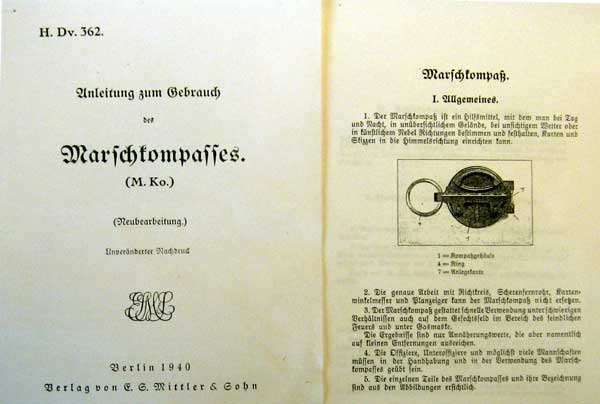 This was the typical marching compass of the Wehrmacht soldiers until 1945. There were several models: most probably, they were first entirely made of brass (case and lid) and the folding ruler measured only 50 mm. Because of lack of material during WW II the products were changed to aluminium. On the other side, the ruler became longer: 60 mm. All compasses featured 6400 mils divisions, counterclockwise. Numerous other details differ (see technical data). |
Compared
lid
shapes (see also Zeiss Ikon):  Technical Data - Diameter: 54 mm - Depth: 17 mm - Weight: 130 g - Case: brass - Lid: brass (narrow nose), hinge with 3 rivets - Ring: nickel - Folding ruler: 50 mm |
 Military marching compass Aluminium model |
 |
Technical
Data - Diameter: 54 mm - Depth: 17 mm - Weight: 60 g - Case: nickel - Lid: aluminium (broad nose), hinge with 4 rivets - Ring: brass - Folding ruler: 60 mm |
 This model features the same case and lid shapes as the BUSCH "Jungendienst- Kompass" which was also manufactured by several other companies. |

 Stamp of the official material control on obverse: the rounded letters "M P" stand for Material- Prüfungsamt, whereas the letters S and 0W stand for the bakelite type and an unknown manufacturer. For more information click HERE. |
Technical
Data - Divisions: counter clockwise - Dimensions: 75 x 55 x 20mm - Weight: 110gr - Case: bakelite - Lid: brass (?), black rough paint The company's name appears in the left corner near the mirror hinge and reads BREITHAUPT or clk depending on the manufacture date. |

 The lid with a big upper case A appears from 1944 on. The case bears no marking at all. |
Official
user instruction (January 10,
1945) The notice to infantry-men (Heeresmitteilung, June 5, 1944) indicates how to use the new A-marked compass with clockwise divisions |
Technical
Data - Divisions: 6400 Mils, clockwise On this model, the needle's main part is concealed behind a black patch with a white bar. This design is also to be found on the F52 and F58 compasses later manufactured by the former Eastern German company Freiberger Präzisionsmechanik (now Holding FPM). The central white bar is located on the W-E axis whereas it is located on the N-S axis on the instruments used later by the Warsaw Pact armies (GDR/Eastern Germany, Poland and Russia - links to examples of items). |
Model COKIL
(COmpass KILometer)  |
 Comment: This compass is now called COKIL (KIL for "kilometers") when equipped with a map reader and COMAR (MARching) when without map-reader. It has also been manufactured in CHINA from 1937 on. Different versions were issued to the Vietcong troops during the US vs. Vietnam war and to the People's Republic of China's Army. |
  Technical
Data Technical
Data- Serial-No. (pic.): 65142 - Diameter: 60 mm - Depth: 20 mm - Weight: 150 g - Case: Aluminium - Ruler (open): 10 cm - Inclinometer in degrees - Map reader: 4 scales - Paint: Wehrmacht verdigris |
 On the dial is the registered trade mark abbreviation (DRGM) used until about 1950. The cardinal point for EAST is indicated with two letters: OE, the O being for the German OST and the E for EAST which means it can have been used by non-German troops. |
On
the exterior
faces is a scale for slopes which is also to be seen on the French
PEIGNÉ survey and artillery compasses (s. this category). (Pictures by courtesy of Peter Spielberg). |
Marching
compass
(late 1940's) This type had a transparent capsule and a bubble level. Technical Data (same as above) It has at both ends of the 10 cm ruler a red and a black sighting device for elevation angle measures. The magnetic needle locking system was a dedicated lever near the compass rose. |
 After
WWII, Breithaupt built from the late 1950s on a fluid-damped
compass called
CONAT
(COmpass
NATO)
for the newly re-created Armed Forces of the Federal
Republic
of Germany (Bundeswehr,
Bw).
As one can see on the patent's figs. (table below) and on the pic
at r., the divisions were first printed under the capsule's upper
surface. In a first project, the serial no. (900 on pic. at r.)
was suposed
to be engraved on the base,
left
of the thumb loop and the pale surface
(designed for writing a bearing) was located on the left-hand side of
the
rear sight. The front sight was a flat triangle which was later
replaced by a groove. The rear sight was Y-shaped. The
screw
for the automatic
setting of the mirror at 45° when opening the lid
didn't exist
first but the tiny screwd-on marker in the line of sight did exist
(later suppressed). The photograph at right was
published in a description
in French language dated 1958*.
It
describes an instrument containing a self-luminescent
radioactive compound
(link
to an
image for a view together
with a radiameter showing a value of 0.94 µSv/h, equal to ten times the
natural background
radiation).
This is confirmed by a Warning
in the official German Army
documentation TDv
6605 (copies available).
After
WWII, Breithaupt built from the late 1950s on a fluid-damped
compass called
CONAT
(COmpass
NATO)
for the newly re-created Armed Forces of the Federal
Republic
of Germany (Bundeswehr,
Bw).
As one can see on the patent's figs. (table below) and on the pic
at r., the divisions were first printed under the capsule's upper
surface. In a first project, the serial no. (900 on pic. at r.)
was suposed
to be engraved on the base,
left
of the thumb loop and the pale surface
(designed for writing a bearing) was located on the left-hand side of
the
rear sight. The front sight was a flat triangle which was later
replaced by a groove. The rear sight was Y-shaped. The
screw
for the automatic
setting of the mirror at 45° when opening the lid
didn't exist
first but the tiny screwd-on marker in the line of sight did exist
(later suppressed). The photograph at right was
published in a description
in French language dated 1958*.
It
describes an instrument containing a self-luminescent
radioactive compound
(link
to an
image for a view together
with a radiameter showing a value of 0.94 µSv/h, equal to ten times the
natural background
radiation).
This is confirmed by a Warning
in the official German Army
documentation TDv
6605 (copies available).
 Pict.
at left: The first CONAT
featuring the supply number
12-123-9866. On some models, the no. was masked with a sticker
6605-12-341-8467. The
Radium-compound paint of the cardinals points
letters and markings has now turned grey.
The magnetic needle was black and red and the closing plate was
transparent (later: black).
Pict.
at left: The first CONAT
featuring the supply number
12-123-9866. On some models, the no. was masked with a sticker
6605-12-341-8467. The
Radium-compound paint of the cardinals points
letters and markings has now turned grey.
The magnetic needle was black and red and the closing plate was
transparent (later: black). Model CONAT
(COmpass NATO)  The patent (no. 1,730,856 - 1956) described a system with a lid/mirror that automatically locked at 45 deg. when deployed and was raised via a double hinge. See pic. below Fig. 1-4.  The mirror must not be folded by hand since this action would deteriorate the automatic erecting mechanism (pic. of warning sticker). |
  A Bundeswehr recruiting advertisement dated 1967 featured a soldier's face in the mirror. Click on the image for a full view of the ad (full-size photocopy available):  "On the right path..." Technical Data - Dim.: 65 x 58 x 20 mm - Weight: 4 ozs. / 120 g - Side rule: 110 mm - Divisions: 64oo Mils, clockwise |
Markings
in the lid: - the manufacturer's logo, - the NATO Stock Number and - the client's designation: BUND or BUNDESWEHR, sometimes with a white dot beneath or only a white or red stamp representing an eagle. The abbr. BWB stands for Bundesamt für Wehrbereich und Beschaffung (weapons design and supply agency). One version featured Tritium illumination* (³H Symbol). The oldest items featured a tiny stop below the hinge. The capsule's production date ist engraved in the bottom (here: 4/90). Three different NSN are known: • 12-123-9866 • 6605-12-341-8467 (sticker) • 6605-12-135-2210 * Decommissioned in the early 90's. Manufacturer's and official military documentation (user instr. and maintenance manual, see pic. below) available.  |

 (Click on image for enlarged view) |
Standard
M-1950 lensatic
compass
used by the U.S. Army. Almost identical with the instruments made
by Cammenga, Stocker & Yale (SandY) etc. These compasses contain self-luminescent Tritium paint (³H) and are weakly radioactive. For more pictures of M-1950 go to CAMMENGA |
Technical
Data - Dimensions: 75 x 57 x 23 mm - Weight: 140 g - Date: 12/62 User instr. available |

BÜCHI,
small
Model I |
 Click on the pictures for enlarged views. |
Technical
Data - Dimensions: 92 x 65 x 18mm - Weight: 130 g - Double distance side scale: 1:50.000 / 1:100.000 User instr. in German available.  NIEDERMANN's Patent: Fig. 1 on page 3 |
Large
model BÜCHI
II  A discrete device (two pins) allowed to measure slopes with the scales engraved on each side of the brown bakelite compass capsule casing (see techn. data) Here: 58% positive |

 View of the side ruler On these compasses a reference is made to a NIEDERMANN patent. Albert Niedermann was issued the patent no. 199,512 for this system on August 31, 1938 in Switzerland (see at right). |
 View opened for placing on a map  Drawing:
NIEDERMANN's
patent (Fig. 1 on page 3)
Technical Data - Dimensions : 94 x 65 x 20mm - Weight: 190 g - Double inclination scale: 0-110% (positive and negative). - Side ruler: distance scale 1:50.000 = 8 km |
 Former
French manufacturer of instruments for hikers
(full name Baudet-Burnat see HERE
-
altimeters, podometers, etc.). He filed several patents. One
about a new system to attach capsule in
compass casings.
Former
French manufacturer of instruments for hikers
(full name Baudet-Burnat see HERE
-
altimeters, podometers, etc.). He filed several patents. One
about a new system to attach capsule in
compass casings.
 (Click on picture above for an enlarged view) Below: The compass card and the 3 luminous points on the capsule:  |
  Top left: The clinometer dial graduated in degres and percent, each scale being printed normal and mirrored. Top right: Measuring a vertical angle by means of the groove and the pin. The angle can be read in the mirror (the red line is only a drawing). Below: descr. in the catalogue of the French camping materiel retailer Au Vieux Campeur (issue 1964).  (Click on pictures for detailed views) |
Technical
Data - Dimensions: 85 x 68 x 20 mm - Weight: 90 g - Double face mirror for compass and clinometer readings - Ruler: 50 mm on hinge - Clinometer graduated in degrees and percent. - Liquid dampened compass card with two luminous points at North. The capsule could be refilled via a special opening (screw on left side). - Three luminous paint points on the capsule: one in the sighting axis, two at 60 deg. on each side.  (Pictures courtesy B. Gairaut - priv. coll.) |
MODEL No. 50 X
CV WITH
TRANSPARENT CAPSULE Taking a bearing is effected by means of a sighting hole and a luminous mark underneath the mirror in the lid. The user instructions (link to photograph) indicates "Radium-compound paint markings" but it's here simply normal luminous paint. |

The clinometer is located on the lid. (Click on the images for enlarged views) |
Technical
Data Dimensions: 78 x 57 x 20 mm  |
 Former German company located in Rathenow (north-west of
Berlin). For more information click HERE.
Look also at the Pocket and the Survey compasses.
Former German company located in Rathenow (north-west of
Berlin). For more information click HERE.
Look also at the Pocket and the Survey compasses.    |
 (Picture above courtesy
of A. Brenner)
The item above also existed with a black face (link to picture). 
(Click
on the images for
enlarged views)
|
Technical
Data - Dimensions: • Overall length (closed): 85mm • Thickness (closed): 20mm • Dia. (case): 55mm - Divisions: 360 deg., clockwise, cardinal points in German - The magnetic needle consists of an lozenge-shaped Aluminum needle with luminous paint at its North end, attached to a short magnetic needle. This arrangement was intended to take the deviation into account. Transit lock: automatic when closing the lid. There were two versions: the probably late one didn't feature the base plate with the sighting aids but only a serrated ring. The face was either bright with a mirror in the lid or entirely black. The illumination system consisted of tiny patches or stripes* of luminous Balmain paper located behind mica protection covers in the lid and the loop fitting, or glued on the needle's north pointing end and on the base plate at the cardinal points. * sometines blackened by varnish, almost invisible. |
| |
(Picture above courtesy
of A. Brenner)
The item above also existed with a black face (link to picture).
(Click
on the images for
enlarged views)
|
Technical
Data - Dimensions: • Overall length (closed): 85mm • Thickness (closed): 20mm • Dia. (case): 55mm - Divisions: 360 deg., clockwise, cardinal points in German - The magnetic needle consists of an lozenge-shaped Aluminum needle with luminous paint at its North end, attached to a short magnetic needle. This arrangement was intended to take the deviation into account. Transit lock: automatic when closing the lid. There were two versions: the probably late one didn't feature the base plate with the sighting aids but only a serrated ring. The face was either bright with a mirror in the lid or entirely black. The illumination system consisted of tiny patches or stripes* of luminous Balmain paper located behind mica protection covers in the lid and the loop fitting, or glued on the needle's north pointing end and on the base plate at the cardinal points. * sometines blackened by varnish, almost invisible. |
| |
(Picture above courtesy
of A. Brenner)
The item above also existed with a black face (link to picture).
(Click
on the images for
enlarged views)
|
Technical
Data - Dimensions: • Overall length (closed): 85mm • Thickness (closed): 20mm • Dia. (case): 55mm - Divisions: 360 deg., clockwise, cardinal points in German - The magnetic needle consists of an lozenge-shaped Aluminum needle with luminous paint at its North end, attached to a short magnetic needle. This arrangement was intended to take the deviation into account. Transit lock: automatic when closing the lid. There were two versions: the probably late one didn't feature the base plate with the sighting aids but only a serrated ring. The face was either bright with a mirror in the lid or entirely black. The illumination system consisted of tiny patches or stripes* of luminous Balmain paper located behind mica protection covers in the lid and the loop fitting, or glued on the needle's north pointing end and on the base plate at the cardinal points. * sometines blackened by varnish, almost invisible. |
|
Model
no. 3350 (BUSCH
catalogue 1930s?) called Militär-Kompass
This model was probably not manufactured but only imported by BUSCH. We only know of versions in Nowegian language.  Click on image for view of description in the catalogue. |
Norwegian
version
(with V for Vest = West).
The museum possesses a version with the following engravings on the lid: the actual manufacturer's name (?) HAKON LUNDE, located STORGAT. 24 and a date (creation of the company?) : 1874. Picture of protection cover and cylindric box. Picture courtesy Totto EIDE (Click on the images for enlarged views) |
Technical
Data - Diameter crystal: 50.5mm / 2 in. - Diameter base: 54.5mm / 2 1/6 in. - Height (case): 14.4mm; sights erected: 33.5mm - Weight: 83grs - Marching line: luminous paint (radium compound on some items) - Cardinals: either black or lum. paint. - Division on the capsule bottom: 360 deg, not visible because masked by the upper ring - Division of the upper ring: 0-60, numbered every 5, each being subdivided in 15 units (3 x 5) i.e. 180 in the whole, each unit equalling 2 deg. - This item also features two lugs. They were however not suited for a wrist strap but to attach the instrument to a small gun (?). - The rotating bush supporting the crystal and sighting aids is maintained by means of a copper wire inserted in opposite grooves (link to pic). |
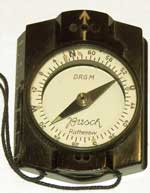 Model X - without mirror (see catalogue below) Compass designed for the paramilitary youth organisation Jungendienst (see MISCELL. / Terminology) 
 Booklets for paramilitary and for civilian users (only the cover picture differs, the issue at right is priobably the older one) |
 Jungendienst compass model XI (with mirror) This case's basic design was used for many compasses also made by PASTO, WILKIE and FPM after WWII.  The compass pouch was made of brown fabric (like the famous shirts). |
Technical
data - Dimensions: 70 x 55 x 18 mm - Weight: 67 g - Case: bakelite - Pouch: fabric - User instr. in various documents like Wehrsporttafel 8 (red, see SHOP) 
 BUSCH was deeply involved in equipping the youth organisation JUNGENDIENST, that replaced the boy scouts (Pfadfinder) organisation and provided a paramilitary training although politically differing from the Hitler-Jugend. In this organisation's manual ("DEUTSCHER JUNGENDIENST", 1933) it is said that the Jungendienst compass was especially developed for the organisation. (Compare with the official Boy and Girl Scouts compasses made by Taylor and U.S. Gauge) Logo in white paint on bakelite cover.  |
 BUSCH catalogue and user's guide, c. 1935  (Click to view teh document open) |
This
case design was also common:
the BREITHAUPT with map reader and clinometer used it and many China
made products also. The first FPM compass used by the East-German
police had the same form. Marschkompass II (marching compass) (Click on the picture above for an enlarged view of logo and leather pouch) At right: An Oberscharführer and a Gefreiter des Heeres (army corporal) with a Mod. II compass |
The
same case but with a
fluid capsule and inverted
colours:
 Technical data - Dimensions: 65 x 57 x 16 mm - Weight: 70 g - Case: bakelite - Lubberline : East-West - Pouch: leather 
 |
 Marschkompass I (military marching compass) Export version for  |
This
is BUSCH's most famous WWII compass. Two different versions existed: a
dry
one (below) and one with a fluid capsule (at right). Technical data - Dimensions: 68 x 55 x 18 mm - Weight: 130 g - Case: brass - Ring: nickel - Folding ruler: 50 mm (Click on the picture for view of compass open) |
 Technical data - Dimensions: 68 x 55 x 18 mm - Weight: 75 g - Case: aluminium with fluid capsule - Folding ruler: 60 mm - Lubber's line: North-South (Click on the picture for view of compass open and dismantled) |
| This compass was found in the foot locker in the estate of an American soldier from World War II. This soldier was a member of the First Special Service Force, also known as “The Devils Brigade”. These soldiers were a combined group of American and Canadian Commandos and saw extensive fighting in Italy including much time at Anzio. | Export
version of the
standard model
evolved from the basic design of the Jungendienst for Fascist Italy's
troops. 
 (Click on the picture at right for detail view of the dial - Courtesy T. Schifani) |
Technical Data - Dimensions: 75 x 55 x 20 mm - Weight: 110 g - Case: bakelite - Divisions : 360 deg. clockwise, cardinals in a latin language (NESO - see Miscellaneous / Cardinals - France) - Radium markings: 2 at North, one at each other cardinal point - Marker for magnetic North at ca. 6 deg. West |
 (Detailed
view: click on the picture at right) (Detailed
view: click on the picture at right)  Note the West- East bar similar to Bézard's. |
Bundeswehr
model 
 The pouch was rectangular like Bézard's. |
 Busch-Göttingen
developed for the Bundeswehr (Bw) a marching compass made of plexiglas
with a transparent capsule and height symbols (building, truck, man
standing) for distance assessment on its casing right side. In addition
it had an adjustable declination mark, rubber feet for better stability
on the map and a slot in the mirror for easier sighting at high
elevation angles. Busch-Göttingen
developed for the Bundeswehr (Bw) a marching compass made of plexiglas
with a transparent capsule and height symbols (building, truck, man
standing) for distance assessment on its casing right side. In addition
it had an adjustable declination mark, rubber feet for better stability
on the map and a slot in the mirror for easier sighting at high
elevation angles.It was probably produced is small quantities at the moment of the Bw creation (1956). Its NATO Stock No. was 6605-12-120-1507. COMMENT: most probably this instrument would have been very sensitive to static charge like the BARIGO (see above). |
 Note the East-West bar on the dial |
  Pictures courtesy D. Engstfeld (Click on images for enlarged views) |
The Police
of Nordrhein-Westfalen
(North-Rhine/ Westphalia) used this black compass type until the late
80's. They possibly have all been discarded but this one! The plastic pouch had a sharp shape. Compasses were utilized by the Police to search large areas with their dogs and possibly riding horses before they had radio and helicopters. |