COMPASSIPEDIA
The OnlineCompass Museum


PLEASE HELP US!
If you would like to be sure that this museum still exists on your next visit, please make a small DONATION (see CONTACT).
Many thanks in advance.
 |
 |
Technical
Data - Case and strap: plastic - Dia.: c. 30mm - Thickness: c.15mm |
 |
 Description in the catalogue (1965, no. 7238 |
Technical
Data - Dia.: ? mm - Height: mm |
 Mini-compass ("conversion") attached to the depth gauge |
 |
Technical
Data - Dia.: 20 mm - Height: mm  |
 Mini-compass AQUASTAR (swiss made) attached to a strap |
 Description in catalogue (1968?), no. 510 |
Technical
Data - Diameter: 1" / 25 mm - Height: 1" / 25 mm |
 |
 Description in a catalogue (item no. 511). |
 Model
LS1 Model
LS1Technical Data - Dia.: approx. 60mm - Height: approx. 60mm - Weight: approx. 150gr - Markings on bottom: LS1, i.e. the inventor's initials Lonnie A. Sutherland and U.S. PAT no. 3,660,907 (1972, see below) |
 
|
 |
- View
from the side: reading the course in a window |
|
This
compass was
made in Japan (s. more Jap. compasses HERE).
 |
Catalog
1897 - Compasses made by different manufacturers
|
Catalog
front page Fall 1900
|


 |
Technical
Data - Diameter: 41 mm - Depth: 12 mm - Weight: 30 gr - Sighting system: rifle-type identical to the Red Army's wrist compasses (AYRKKA, ZUP etc.) - Transit lock: side (screw head) - Inscription on the floating disk: МОДЕЛЬ APT. TEX. (Артелерийской Техники) - Model for artillery technique. (Click on picture for enlarged view) |
 Swedish and U.S.
manufacturer (for more information click HERE
and also in Wikipedia about Johnson Outdoors).
Swedish and U.S.
manufacturer (for more information click HERE
and also in Wikipedia about Johnson Outdoors).
1 -
Wrist Compasses: Model
Globetrotter
 Picture at right: ad c.1950 Technical data - Diam.: 2" (50 mm) - Cardinals: swedish - Inscriptions on the back: SILVA - A.-B. BROD. KJELLSTROM - Stockholm Sweden - 68 - U.S.A. Pat. 2136970. The object of the patent filed by Henning Rudolf Ekkeberg in 1937 was a fluid capsule capable of resisting variations of the fluid volume due to temperature changes. (Copy in English available) |
Model Cruiser
(1955)  Pic. by courtesy of Douglas Carter (Click on image for detail view) Picture as published in B. Kjellstrom's famous book Be an expert with Map and Compass, 1955 (see details in Marching compasses)  The model Cruiser was only produced in the U.S.A. |
View
of the Cruiser
reverse
side with Swedish (SV) and U.S. patents no.
 Technical
data
- Dia. overall: 35 mm - Dia. capsule : 23 mm |
Model
name ?
Picture by courtesy of Douglas Carter Technical Data - Dia. : mm |
Model
Silvette ?  Picture by courtesy of Douglas Carter Technical Data - Dia. : mm |
NOTE:
A wrist compass called Model no. 11 SILVETTE
is
listed in a user
instr.* but we have no picture of it. Thank you for helping.
Maybe it is one of the compasses displayed at left. * Colour photocopy available |
2
- Pin-on
(Lapel) Compasses model Huntsman  Below: German Luftwaffe (survival kit)  
 From l. to r.: Mil. markings - Sundial - Compass open |
Sun-watch
flap
function and ser instructions in box
  The Bundeswehr
Huntsman together with the other items of the survival kit (for more information
read
note below)

|
Technical
Data - Dimensions (folded): 46 x 38 x 10mm - Weight: 33gr - Sun watch function - Date: 1950's Advert. with user instr. (1954)  * Compare with MARBLE'S, WILKIE and TRU NORD. |

 The VZ compass in the 1960 Spirotechnique catalogue. Patent no. 1.189.600 issued on Oct. 5, 1959 (for illustr. click HERE). (Photos by J. GRÉPINET, see LINKS, COMPASSES FOR DIVERS) |
Model
VZ or
Sphéricompas  |
Technical
Data - Strap: plastic Dimensions - Diameter (sphere): 45mm - Height (sphere + basis): 55mm  -
Weight: 95gr -
Weight: 95gr
(Pic. at left courtesy militarybill) Export version (USA) marked U.S. DIVERS |
 Pictures by courtesy of J. GRÉPINET, (see in LINKS: COMPASSES FOR DIVERS) |
Model
ALBATROS Click on the image for enlarged view |
Technical
Data Strap: plastic Dimensions - Dia.: 50mm - Thickness: 35mm - Weight: 80gr - Manufactured (approx.): 1950's-60's |
Model
VESPER |
 Pictures courtesy A. Ribeiro - Click on the images for enlarged views |
Technical
Data Markings: - VESPER (on face, the letter S is partly masked by a rivet) - LA SPIROTECHNIQUE (on back) Dimensions - Dia.: 1 ¾ " (45mm) - Thickness: 11/16 " (17mm) - Strap slot width: 5/8 " (15mm) |
 (Click on picture for enlargement) |
 Reverse side |
Official
model formerly used by the French Police and the divers teams of the
Fire Brigades (Sapeur Pompiers) Technical Data - Casing: polyester - Diameter: 70 mm - Depth: 50 mm - Divisions: 360° - Filling screw on side, sticker "GLYCOL" on reverse side - Manufactured (approx.): 1970's |

 (Click on the pictures for enlarged views) |
 The Singer's
patent type dial. The
North mark is a red square with a vertical line of Radium- compound
paint across
it.
|
 Technical
data Technical
data- Diam.: 48 mm - Depth: 20 mm - Divisions: 360° Right: view of a catalogue |
 (Click on the pictures for enlarged views) |
 Same design but in
addition a red marching course line on the crystal.
|
 Technical
data
Technical
data- Diameter: 45 mm - Depth: 16 mm - Divisions: 360° Siebe Gorman & Co. 1957 catalogue |
Plain
version (dim. unknown) Picture courtesy Harvey Withers |
 Conventional version featuring a SINGER dial Technical data - Diameter: 35 mm (case) resp. 20 mm (dial) - Depth: 14 mm - Protection lid - Divisions: 32 points, Radium-compound paint markings (N, E & W, one dot for south) |
 Technical
data Technical
data- Dia.: 40 mm (case) resp. 20 mm (dial) - Depth: 14 mm - Protection snap lid - Divisions: cardinals and intercardinals only |


| WWII
Paratrooper
compass Design see CUDE patent.  (Click on the picture above for an enlarged view) See also TAYLOR for the differences between both. |
Markings
on the
casing: 
|
 Paratrooper with his compass (1944) (Picture courtesy U.S. Army) |
Technical
Data - Diameter: 55 mm - Depth: 18 mm - Weight: 63 gr (with strap) - Divisions: 360°, clockwise - Material: plastic - Colour: greenish-brown  Above: A. & F. ad (Click for enlarged view) |
| Korean
War (June
25, 1950 - July 27, 1953) Paratrooper compass  |
Markings
on the
casing:  |
Technical
Data - Diameter: 51 mm - Depth: 18 mm - Weight: 68 gr (with strap) - Divisions: 360°, clockwise - Material . Casing: metallic . Inner capsule: plastic - Colour: greenish-brown - Date: 9-50 |
Fig.
of original patent with graphical user instructions (Polish version,
identical
to the Finnish version) |

 Pic. at left: German version of the Finnish patent (accepted in 1934, published in 1941).The versions in Polish and Engl. languages (Gr. Britain and Canada) are also available: ask the curator. Pic. at r.: Page 1 of the German user instructions. Note the compass designation: P 1 (Click on the pictures for enlarged views) |

 Top left: Fig. 1 and 2 of the German patent Top right: German version used during the alliance with Germany (WWII) and common fighting of USSR. The divisions on divided circle were engraved clockwise and countercockwise (link to pic.) |
 Model name: M-37 Markings: SA*/T, PMT *Suomen Armeija = Finnish Army |
 Correspondance
formula for degrees (astetta) and mils (6000, piirua).
100 piirua = 6 astetta 1 aste = 17 piirua Picture at right: full table Four rulers for direct reading of distances on maps: 1:20.000, 1:50.000, 1:100.000 and 1:42.000 |

 Technical Data - Strap: leather - Case and bezel: aluminum - Dimensions: 53 x 53 x 23 mm - Weight: 125 gr - Divisions: 6000 mils, counterclockwise - Logo in lower left corner: S-KO-HA = Suojeluskuntain osuushankintakeskus. The Suojeluskunta (or White Guard, s. Wikipedia) was a semi-official national guard before and during World War II (source: K. Pienimäki) |
 Model M / III built by PHYSICA A/B HELSINKI  |
 Four
rulers for
direct reading of distances on maps: 1:25.000, 1:500.000, 1:100.000 und
1:1.000.000.
|
 Technical Data - Strap: leather - Case: aluminium - Bezel: brass - Dimensions: 53 x 53 x 23 mm - Weight: 125 gr - Divisions: 360 degrees, counterclockwise - Ruler 50 mm |
 |
 Army version with a black bakelite back plate and a 1:20,000 scale on one side. |
 Technical data - Strap: leather - Case and bezel: aluminum - Dimensions: 53 x 53 x 23 mm - Weight: 125 gr - Divisions: 6000 mils, counter clockwise |
 Model with transparent bottom |
 Pictures courtesy J. Shannon |
Technical data |
 |
 Pictures by courtesy H. Waldmann |
Technical
data Model featuring a large divided bezel The external ring features grooves only on one half / 180°. |
 Divers' compass (counter clockwise) |
 Pictures courtesy F. Rothbrust and D. Latenser |
 Model
signed Suunto Oy Helsinki made in the 1970s. It had the same hole in
the bezel glass as the ABALONE
model made by
PASTO. Through
this opening the water
could flow freely and the glass was not pressed by the pressure but a
lot of dirt could also enter and it was difficult to rinse. The disign
was soon abandonned. Model
signed Suunto Oy Helsinki made in the 1970s. It had the same hole in
the bezel glass as the ABALONE
model made by
PASTO. Through
this opening the water
could flow freely and the glass was not pressed by the pressure but a
lot of dirt could also enter and it was difficult to rinse. The disign
was soon abandonned. |
 |
 |
Model M-9 featuring a sight through the case side |
Type
name SK-65 Compare to the WILKIE and LUFFT models |
Type
name
ORIENTSUB |
Paratroopers'
compass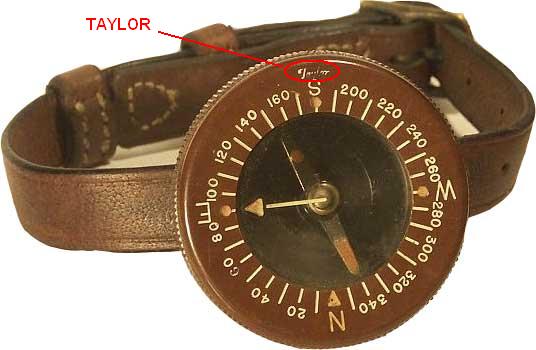
 (Click on the picture at left for an enlarged view) Main differences between the Sup. Mag. and the Taylor versions: - The brand name Taylor is indicated on the crown's rim. The figures are small and the cardinal points large, leaving an empty margin between them and the rim. When tilting the compass against the light one can see a spiral design (pict. at right). - The magnetic needle is triangular and broad whereas the SUP MAG's needle is thin and straight. The big arrow point for the marching course on the plastic crystal is filled with paint from above, it is very thin and painted from under the crystal on SUP MAG. |
Markings
on the
casing, masked when the strap is installed: - TAYLOR Logo  - ROCHESTER N. Y./U.S.A. On some items, a date is printed on the back of the spiral bottom plate. |
Technical
Data - Diameter: 58 mm - Depth: 20 mm - Weight: 60 gr (with strap) - Divisions: 360°, clockwise - Colour: brownish-red Side view of the crown: Top: SUPERIOR MAGNETO Bottom: TAYLOR  |
| Divers
compass (catalog 1961)  Click on the pictures for detailed views |
 Divers compass Technical Data - Diameter: 55 mm - Depth: 40 mm - Weight: 100 gr (with strap) - Divisions: only the main cardinal points are marked by a letter. The middle positions are marked by dashes and dots. Depth gauge with built-in compass: go to VOIT. |
 Hikers compass Technical Data - Diameter: 35 mm - Depth: 10 mm - Weight: 35 gr (with strap) - Divisions: only the main cardinal points are marked by a letter. The middle positions are marked by a dash. North and South have in addition a luminous paint mark. - Production period: early 1950's ? |
 Technical Data - Diameter: 45 mm - Bezel: - Date: 1950-60s?? |
Pin-on
compass  |
The black and white card's design on the wrist compass above and the pin-on compass left is a negative copy of the original TRU NORTH's design (see patent's fig. below in TRU NORD). |
 (Click on the images for enlarged views) |

|
Technical data - Compass dial dia.: 1 in. / 25 mm - Production period: 1970s ? - Below: current version (2016)  |
 Pictures by courtesy of R. Griggs (Click on the images for enlarged views) |
 Marking: TURNBULL & co MAKERS EDINBURGH |
Patent
drawing and detail view of designation

|
 Click on the picture for a detailed side view Link: view of the box and user instruction |
  The small size is not problematic since the objects appear enlarged under ater. |
Technical
Data - Dimensions: 48 x 28 x 22 mm - Weight: 17 gr (with strap) - Divisions: only the main cardinal points are marked by a letter. The middle positions are marked by a dash. West is on the right of true North like on spherical nautical compasses). - The dome's shape is designed so as to concentrate through optical magnification even faint light onto the horizontal card, 50% of which is seen in a mirror. - The internal volume is extremely small (cyclinder: 18mm x 5 mm) and doesn't need thus to contain any fluid (see side view pic. at left and view from below). The compass is an insert marked: MADE IN U.S.A. - PAT. PENDING. |
 (Pictures arkmay2 - priv. coll.) |
 Click on the pictures for enlarged views |
Technical
Data - Diameter: 32mm - Length: 65mm - Weight: 42gr - Divisions: only 4 cardinals Radium paint markings: outer borderline of North arrow, line between needle cap and South. Black and white card similar to SINGER's pattern. |
 Newest face design. Brass model 300C |
 Titanium modell 100CT Click on the pictures for enlarged views |
Technical
Data - Diameter: 1.062 in / approx. 25mm - Divisions: 360 deg - Case made of brass or titanium Compare to TEXSPORT above |


|

|
ADRIANOFF-type
compass Technical Data Dee Adrianoff Picture courtesy tjtoolie |
 UOMZ
/ YOM3 is the abbreviation
of Уральский оптико-механический завод, Свердловск
(Екатеринбург)
i.e.
Ural
Optics and Mechanics (plant), Sverdlovsk (Yekaterinburg). In the 19th
century it was Theodor Schwabe's manufactury. In 1916 it was
renamed to "Geofizika". Then it was renamed to "Goszavod Geofizika"
(Goszavod is a short name for state-owned factory). Next name
was
VOOMP Geofizika. In 1940 it was evacuated to Sverdlovsk because of the
Nazi-Germany attack in 1941. There it was renamed to UOMZ (Ural
optical-mechanic factory) and is still working under this name today.
UOMZ
/ YOM3 is the abbreviation
of Уральский оптико-механический завод, Свердловск
(Екатеринбург)
i.e.
Ural
Optics and Mechanics (plant), Sverdlovsk (Yekaterinburg). In the 19th
century it was Theodor Schwabe's manufactury. In 1916 it was
renamed to "Geofizika". Then it was renamed to "Goszavod Geofizika"
(Goszavod is a short name for state-owned factory). Next name
was
VOOMP Geofizika. In 1940 it was evacuated to Sverdlovsk because of the
Nazi-Germany attack in 1941. There it was renamed to UOMZ (Ural
optical-mechanic factory) and is still working under this name today. Click on pictures for enlarged views) Below: rear side of leather holder:  |
 Inscriptions
on the
dial:
- Top (in Russian): NORTH BLUE (North is where the needle's blue end points to) - Left side: the Soviet Union's and the Red Army's symbols (hammer and sickel, a 5-branched star) and a logo representing a beam crossing a concave lense and being reflected by a mirror. |
Technical
Data Compass alone: - Diameter: 2.94" / 75 mm - Depth: 0.78" / 15 mm - Weight: 150 gr - Manufactured: 1942 - Divisions: 6000 MILS, counter-clockwise - Strap length: 11" 7 / 30 mm NOTE : This large compass was originally not intended to be born at the wrist: it was part of an aiming circle used in the USSR's Red Army and designed by Mikhalovski & Touroff. It is however a well done and maybe unique makeshift product. All fixations are rivets and it cannot be dismantled. |
 |
 (Click for enlarged view) |
Technical
Data - Dia. of sphere: 35mm |
 For a detail view pls. click on image and go also to AQUA-LUNG. |
 |
Technical
Data - Dia.(overall): 65 mm - Dia. of compass: 45 mm - Divisions: counter clockwise - Combined instrument: depth gauge and compass |
Compass,
wrist , non liquid, Type L-1, Spec no. 21051-A (Detail view of the dial: click on the picture above)  |
 Reverse side view w/o strap. Compare with the compass made by Marine Compass Co. (Click for enlarged view) |
Technical
Data - Diameter: 46 mm - Depth: 21 mm - Weight (strap incl.): 35 gr - Divisions: 360°, clockwise - Strap width: 14 mm  USG ad. (Click on image above for full text) |
 The small modell called trail-blazer with leather strap and a view of its box (below). Inside the lid: the unser's instructions:  
(Click on the pictures
for enlarged views)
|
 Note the words YOU ARE LOOKING on either side of the lubber's line. The compass was available with a whit eor a black case. |
Technical
Data - Case width: 28 mm - Depth: 20 mm - Weight (strap incl.): 15 gr - Divisions: ship compass type - Strap width: 16 mm - Liquid damped rose 
|
 |
Denis
Maurice
VAUCHER, wrist compass Patent no. 557.020 (Switzerland 1973), 3.919.782 (USA) and 324.726 (Austria) |
| Model
DG4-C Depth gauge with built-in compass  Pictures courtesy Dušan Šuráni (Click on the images for full view of ad) |
VOIT-BRANDED
TAYLOR
DIVER's COMPASS |
DG4-C Technical
Data - Dia.: 55mm - Height: 44mm - Weight: 125gr - Date: 1950s-60s |
 (Click on image for detailed view) |
 Technical
Data Technical
Data- Diameter: 29mm  - Thickness: 10mm - Thickness: 10mm- Weight: 20gr - Marking (on rear face): R-88-C-890 (see box at right) - ca. 1956 (Korea war), two version existed: with graduations (above) and without but with the maker's name. |
 (Click on image for detailed view) |
SEAL
diving compass. The United
States Navy Sea, Air and Land Forces, commonly known as the Navy SEALs,
are the Special Operations Forces of the United States Navy, employed
in direct action and special reconnaissance operations. SEALs are also
capable of employing unconventional warfare, foreign internal defense,
and counter-terrorism missions. (Definition: WIKIPEDIA) Technical Data - Diameter: 58mm - Thickness: 22mm - Weight: 190gr |

(Click on image for detailed view) |
Tiny
compass looking like a lady’s watch,
fitted on a slim
high-quality leather wristband, featuring a rotating capsule with a
lubber line under the glass and a dash of luminous paint as a north
reference located in a slot on the case rim. Technical Data - Dia. (compass): 17mm - Thickness: 8mm - This item is identical to the NATO escape compass |
View of the
side
lamp connector (Click on the pictures for enlarged views) |
The
dial as seen lit through the side window
 |
 WBT's logo on the North fleur-de-lys |
Technical
Data - Diameter: 2.5" / 67 mm - Depth: 1.5" / 29 mm - Side port dia.: 16 mm - Weight: 0.5 lb. / 250 gr - Compass card divisions: 360° - Course reference : a needle (s. pic. below)  |
| DIVERS
COMPASSES Type
UK 45 F and UK 46 F Catalog published in the 60s (left) and 1972 (right) 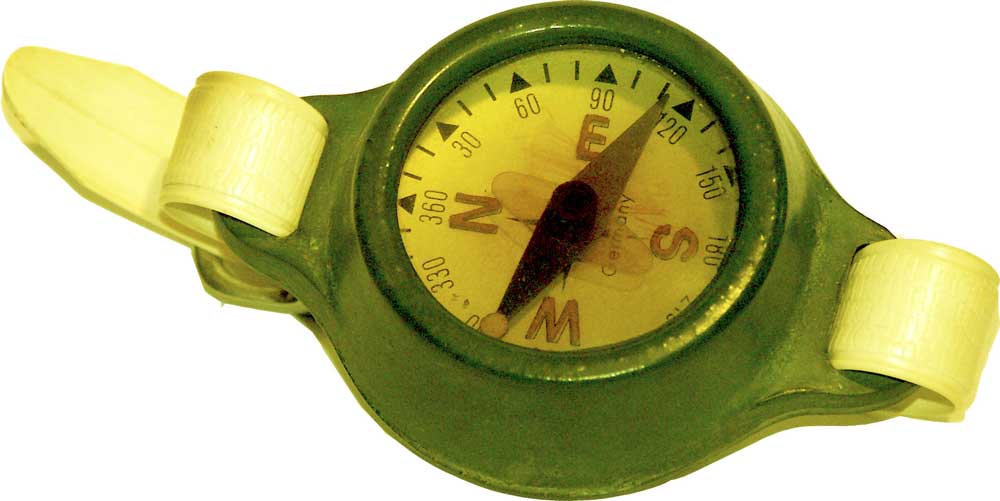 
See also the predecessor versions made by PASTO. |
DIVERS
COMPASS UK 45 F    The item at left was also utilised by the predecessors of the US NAVY SEALs (UDT) in Corea and Vietnam Picture
at r. courtesy U.
de Pulgas
|
| DIVERS
COMPASS Type UK 46 F (flat) (compare with PASTO, catalogue 1971)   (For view dismantled click HERE) Technical
Data -
Capsule dia.: 1" / 47mm, outer
dia.: 57mm,
Height: 17mm.
Fluid-filled, Needle with stabilizing winglets. Divisions: every 10 deg. Card material: aluminum. Jewel cap, strap material: synthetic. |
DIVERS
COMPASS Type UK 47 F
(spherical) UK = Unterwasserkompass (underwater compass) F = Flüssigkeitsgefüllt (fluid-filled) (Pictures: catalog for the year 1972)  |
  Pictures courtesy Franz Rothbrust (Click on images for enlarged views) WILKIE
proposed also
several models of combined instruments depth gauge/compass. Models with
0-80 m and 0-100m scale.
Compare to the model sold by DRÄGER. |

 (Click on images for enlarged views) Export Model 250 GC with 0-250 ft scale in the catalogs 1965 (needle w/o stabilizers) and 1972 |
 (Click to enlarge) |
This
compass (Type AK, s.
catalogue
below) comprises a typical WILKIE fluid capsule secured in the casing
by a crown-shaped nut exactly like the MARBLE'S
pin-on compasses. |
Technical
data - Diameter: 32mm - Depth: 15mm - Weight: 44gr - Round knurled nut |


|
HIKERS'
COMPASSES TYPE AK 30 F 
(Click for enlarged view) |
  Capsule like above, hexagonal nut |
 |
 TYPE AK 1 F Pictures courtesy Doug Carter |

|
 |
  |
HUNTERS'
PIN-ON
COMPASS -
Type H
30 F |
THE
SERVICE WRISTLET (Click on images for enlarged views) |

|
 |
Technical Data - Compass dia.: 1 ½ in. / 35 mm - Production period: WWI - Divisions: 32 rhumbs (s. Menue Miscell. / Divisions) Pictures courtesy bbant29 |


Click on the image for an enlarged view of the dial |

 Z.O.P.'s logo: the letter P stands in the centre, Z and O are mingled and tilted by 45°. The lower part of the body with knurled side wall rotates. |
Technical
data - Diameter: 42 mm - Height: 12 mm - Weight: 42 g incl. band - Divisions: 6000 MILS, counterclockwise - Material: nickel? - Rest of black paint. |
 Model name ADRIANOVA |
 |
ZUP's
logo
 (Picture Bajo /
MilitariaFundForum)
|
Technical
Data - Diameter: 50 mm - Depth: 20 mm - Weight: 60 gr - Graduations: . 360 degrees clockwise (inner scale) . 6000 mils anticlockwise (outer scale) - Date (at case underside) : 1940 |


