The word
cardinal
is taken
from the Latin
cardo
which
means a hinge. The oldest names known (in the Mediterranean
area)
for the
four
cardinals are probably the ones used in
ancient Egypt
and in the Old
Testament and were
hence
coined at least 4000-3500 years from now.
The Egyptians, like the
Chinese
(
s.
table below) by the way,
defined the directions facing south (
resut *)
and north (
mehet)
behind them. East and west were hence called
like left
(
jAbt
/ yapteh)
and
right (
jmntt
/ yemnet). South
was not only the position of the sun (the god
Ra)
at
noon, it was also the origin of the life-sustaining
river Nile. (
*
Note : The transcription is the German one since this information
was given by the Munich Egyptian Museum).
The four
cardinal points are
recurring elements in Pharaonic thought. They are closely associated
with the apotropaic rites performed by Pharaoh to maintain the
integrity and stability of the country. By targeting the four
cardinal points with selected projectiles (balls, bullets, arrows),
he affects the peoples located beyond the borders of Egypt, the
Nubians in the south, the Asians in the north, the Libyans in the
west and the Bedouins in the east. All these forces of chaos
symbolized by the god Seth, the troublemaker, towards whom these
projectiles are thrown. These throws always start towards the South
as in the ritual of the four balls (Osirian ritual). See the Brooklyn
papyrus 47.218.138 which states: "Another formula for closing
the mouth of any reptile for the benefit of Pharaoh" where the
first of the balls sent against Seth is directed towards the South
rsy**
(engraved with the names of Amon and Montu), the second towards
the North
mḥyt
(bearing the names of Shu and Tefnut), the third
towards the West
imy-wrt
(bearing the names of Neith and Wadjet) and
finally the fourth towards the East
í3bt (bearing those
of Sekhmet
and Bastet). The scene is represented on the lintel of room IV of the
Osirian building built by Taharqa at Karnak. The order of the throws
corresponded to the degree of danger of the neighboring peoples and
has varied throughout history. Source: Explanations provided by the
documentation service of the Louvre Museum, Paris.
** Note: The
transcription is the French one.

 LATIN AMERICA
 - The
ancient
Maya
language and calendar had many
various
representations
of the cardinal points. The
Indians in Mexico and Guatemala still
perform the dance of Voladores (see Wikipedia) : the four ropes
represent the cardinals, a fifth man on top of the pole symbolises the
sun (sometimes, a sixth one stands for the moon). They rotate in 13
turns down to the ground. The product of 13 x 4 is 52 equaling the
number of years in the Maya / Aztek calendar.
Picture at left: The cardinal point west (chik'in) courtesy ARTE,
Deciffering the Maya code after M. D. Coe.
Picture at right:
„El Tajin Los Voladores fcm“ by
Frank C. Müller. Licensed under CC-BY-SA 4.0 Wikimedia
Commons.
https://commons.wikimedia.org/wiki/
File:El_Tajin_Los_Voladores_fcm.jpg#mediaviewer/
File:El_Tajin_Los_Voladores_fcm.jpg
The cardinals also were
Israel's
borders,
i.e.
the verdant mountains of Lebanon to the north (in Hebrew
Tsafon),
the barren
mountains of Edom to the east (
Kedem), the
desert to the south (
Negev)
and the Mediterranean to the West (
Yam
= sea). Source:
The
riddle of the compass by Amir
D. Aczel.
The linguist Guy Deutscher explains in the
New York TIMES
how the native speakers of the
Australian
aborinal tongue
Guugu
Yimithirr (North Queensland)
use the cardinal directions to
describe things where we usually say left or right, in front of or
behind oneself, words that they don't know, and orientate themself
immediately and automatically while speaking.
Symbolism of the
cardinal points
The European civilisations and the philosophers have associated with
the cardinals points common characteristics —often
contrary— of the people living in the regions lying there.
Examples: North was for the ancient Greeks the place where
barbarians but also men of great wisdom lived, but for the people
living there, south was characterized by the joyful life (sun versus
fog) but also with the lazyness provoqued by the heat... The French
journalist and philosopher Roger-Pol Droit published in
Le Monde
(July and Aug. 2014) fours articles about this topic (
copies available).
 The
rose of the winds
The
rose of the winds
(or wind rose) was so named because the
divisions
of the circle were originally named after the main winds
blowing
in the Mediterranean. The four main ancient Greek
wind names were:
Boreas
(cold north wind),
Apeliotes
(east wind),
Notus
(dry
south wind),
Zephyr
(warm west wind) from the tower of the
winds in Athens. These wind names were later noted with their
initial
letter (see below and examples in the table : Spanish map dated 1583,
and in
the section Nautical Compasses the instruments signed by
BAUDUF
and
ROUX).
The names are indicated in full words in different languages
on
some descriptions, such as on the print at the top of page)
generally in Italian, but also in Spanish, Provençal or
Latin.
The windrose at right also gives names for a further
subdivision (32 points) like
aquilin
or
zéphyr,
which
should be well-known to all those who learned the
famous French poems
written by La Fontaine, Le Chęne et Le Roseau: "
Tout vous est aquilin /
Tout me
semble zéphyr "
(The oak and the
reed: "What for you is a North wind is for me but a Zephyr").
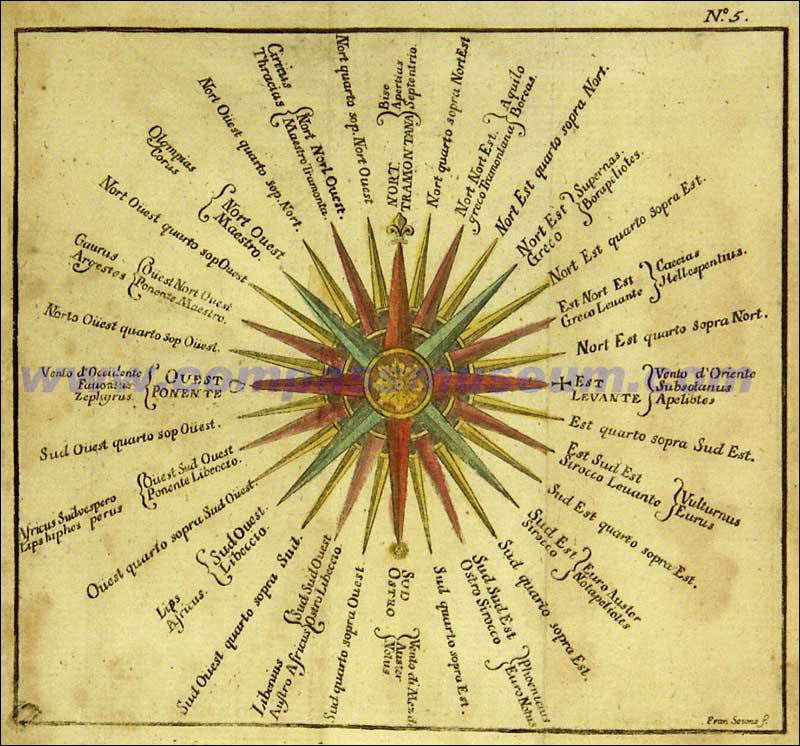
Pic.
at right - This print was part of an ancient book by the famous French
cartographer Nicolas Sanson d'Abbeville (1600/1667),
re-edited bei TERRES in Naples in 1794. Click on image for enlarged view
At some time in Greek antiquity, only north and south were
fixed
directions. The names of the winds blowing in between gave birth to a
total of twelve names in four groups (Aristotle, more details in
Thomson - see Bibliography below):
 Northern
:
Thrakias, Aparktias,
Boreas
Eastern:
Kaikas, Apeliotes,
Euros
Southern:
Euronotos/Phoinikias,
Notos, Libonotos
Western:
Libs, Zephiros,
Argestes.
See more mediterranean wind names in the ITALIAN entry in the
table below.
Picture at right: In Russia and
countries with orthodox churches the cross features a tilted lower bar
aligned on the north-south axis. The end pointing to the sky is the
northern end.
For more information read
L'origine
de la rose
des vents et l'invention de la boussole
by Leopold de
Saussure, Geneva 1923, 64 p.: critical review and complement to the
famous
Lettre ŕ
M. le
baron Alexander von Humboldt sur l'origine de la boussole
by J. Klaproth and also the
The
rose of winds: the
origin and
development of the compass card
by Silvanus P. Thompson,
London 1913, 45 p. (check also Miscell. / History and Literature).
 INDONESIA
The roof of the hindu temple (joglos) is sustained by four
columns (Sokoguru) of (sacred) teak wood which represent the
cardinal points (picture ARTE).
Wind roses with decorated East cardinal on ancient maps:
Map
of Puerto Rico
(drawn South up)

(Click
on the picture for an
enlarged view) |
Portuguese
map
(1590)
 |
Spanish
map
(1583)
 |
Dutch
map
(c. 1700)
 |
Map
of Corfou
(Greece, 1990)
 |
East-decorated
compasses - and a WEST-decorated one
Ship's
compass by
J. B. Leroy, Jersey

|
Ship's
compass by
David Stalker, Leith

|
Sundial
by
J. Urings, London

|
Surveyor's
compass by
J.& H. M.
POOL, Eston, Mass.

(All pictures by Jaypee - priv. coll.)
|
Nautical
compass by FLINT,
with WEST-decorated
rose of
winds
 |
THE NAMES OF THE
CARDINALS ON COMPASSES IN SOME LANGUAGES
Nowadays, the cardinal points of almost all compasses in the world are
written in English (N-E-S-W for North - East - South - West). In
ancient times though, the abbreviated Latin designations were used by
Westerner
compass makers and in many countries the cardinals were indicated in
the national language. Here are some examples:
North: SE = septentriones
East:
OR = oriens
South:
ME = meridies
West: OC = occidens
For more details on this item,
go to Sundials/Equinoctial, Augsburg type
(Picture
by
courtesy of
E. Tulchinsky/seattlesbestart)
Right: View of Rainkam castle (Bavaria) with a
compass scheme by M. Wening, 1701 (picture Jaypee, click for enlarged
view)
|
 
|
North:
shamal,
etymology: Sham-al
= a statue / god which stood North of Arabia
East: sharq
(q = hard k), etym. shoroq
= sunrise
South:
janoub,
etym.: janb
= side
West: raRb
(pronounce the 1st r
like in French and the 2nd like in Spanish), etym.: ghorob
= sunset
(source:
Yahoo! Q/A - Hakim)
See
also category Religion
(Islam)
Other example: OMI
(Saudi Arabia)
|


In the picture above,
East is written in the old way with the letter Q for qibla
but on the
compass dial the letter SHIN was used for both North and East.
|
|
The Gaelic language spoken in France (Bretagne) is called Breton. |

|
Like Russian except for the East which
is called  (pronounce iztok)
instead of BOCTOK
(pronounce vostok).
(pronounce iztok)
instead of BOCTOK
(pronounce vostok). |

|
The different ancient systems are described in the sections
RELIGION /
Chinese
Tradition
and Nautical Compasses
/
China. A compass is called in Chinese Luo pan. According to the five
elements theory (Wu Xing) each cardinal is related to the colour of an
element: north with water i.e. blue or black, east
with wood
i.e. green or brown, south with fire i.e. red
or orange ans
west with metall i.e. white or silver. Compare to JAPAN.
Traditional
symbols in
astronomy:
North
=
black turtle
East
= blue dragon
South
= red bird
West
=
white tiger
North:
北
(Bei)
East: 東
(Dong)
South: 南
(Nán)
West: 西
(Xi) |
Below:
written names on compasses. Each sign is to be read
from the compass center point.
NOTE:
The transcripted phonetic
value can strongly differ in
the
different languages (see the words used by J. Klaproth in
1834) in RELIGION and NAUTICAL compasses.

Classical characters
(Click on image for
enlarged view) |

Modern characters (military compass)
|
North = SEVERNÍ
East = VÝCHOD
South
= JIH
West = ZÁPAD
Note
: The dial features a graduation in 6400
mils (see Divisions/Mils)
|

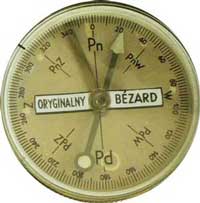
Descr. : Bézard
/ Imitations / Czechoslovakia |
North : nord
East : řst
South : syd
West : vest
|

|
North: Noord
East: Oost
South: Zuid
West: West
Pic at right: The harbour's official wind vane on the Holland Amerika Lijn house
in Rotterdam (click
on the image for a detail view) |


|
North - East - South - West
These letters are now the worldwide standard abbreviations Picture at
right : a Bézard export version.
|

|
Nord - Est - Sud - Ouest
These letters were also used in most roman languages like Spanish,
Italian and Portuguese.
Romanian is a little bit different (see below)
|

|
North: Tuath
East : An Ear
South: Deas
West: An Iar
(Click on img. at right for full
view of
the 32 points)
|
At the beginning of the
20th century, Gaelic was still
a
common
language in Scotland.
 |
|
Originally, the cardinals would be indicated in Latin. It was also
common to refer to the sun's position in the sky. There is a
map
Nuremberg and surroundings drawn for the purpose of showing the places
nearby that belonged to it and had to pay taxes. We can read on it
steht Mitternacht
(midnight) for north, Auffgang
(sunrise) for east and Mittag
(noon) for south.
|
    |
Nord - Ost - Süd - West
The cardinals' names are to be
declinated (nach
Norden
fahren = to go north, Süderelbe
= southern Elbe river in Hamburg) but the
ending can be omitted in poetry (see drawing at r.: France-Prussia war,
1870)
|
 This compass is divided into 6400
Mils (see explanations in Divisions) This compass is divided into 6400
Mils (see explanations in Divisions)
.
 |
North: észak
East: kelet
South: dél
West: nyugat
On this compass, the zero/6400 MILS faces the South mark (D) and North
(É) is facing 3200 MILS.
(See Bézard, Gamma and MOM for more explanations)
|
 |
Engl. / Urdu / Sanskrit (Hindi)
- North: (uttara) شمال
/ उत्तर
- East: (pūrva)
مشرق
/ पूर्व
- South: (dakṣiṇa)
جنوب
/ दक्षिण
- West: (paścima)
مغرب
/ पश्चिम
The dial of the compass at left features cardinals (only E, S and W,
North
being represented by a fleur-de-lis) both in Urdu and Sanskrit
languages
|


Picture
above left by
courtesy of The Boreal Arrow
- At right: a ship's compass
card in Sanskrit
(Click
on the images for detailed views)
|
The
letters for the eight winds were generally (clockwise in
45°
steps):
- North: T
for Tramontane before the fleur-de-lys (heraldic
lily) was
generally used at some moment in the 16th c. Some authors
like L. de Saussure presume that the fleur-de-lys
design
evolved from the uppercase letter T. Other names: bise
(cold north wind in French),
septentrio
(Latin), also
represented by seven stars. It was long argued that the origin of the
lily might have been the fact that the
makers
of nautical compasses who lived in Naples (Italy) had maybe
chosen
this symbol because it was in the coat-of-arms of the "Anjou
Empire" (i.e. France) whom the Kingdom of Sicily and Naples
then
belonged (13th C.) but this is historically inconsistent.
(cont'd at right)
|
 - N-E: G
for Graeco (Greek), a wind blowing from Greece to south Italy/Sicily. - N-E: G
for Graeco (Greek), a wind blowing from Greece to south Italy/Sicily.
-
East:
sometimes L
for levante,
i.e. the direction of the rising sun as well as various decorations
(see
tables below). The symbol used for the East was a christian cross
showing the way to Jerusalem
but also the letter E
for este
(see below on the map of Puerto
Rico). This information, which
only had
a religious background, is no longer used on contemporary maps or just
for decoration. The most recent that we know of was printed on a
Corfu, Greece, tourist map for the year 1990.
- S-E: S
for Sirocco, a warm
wind blowing from Africa
- South:
O
for Ostro (also
austro = south, as in
Austria
and
Australia)
but also
called meridio,
vent marin, vent de midi (mezzogiorno),
- S-W: L
for Libecchio, labech, lebeche, a wind crossing Italy and
Corsica,
- West:
P
for Ponant,
ponente (setting sun),
- N-W: M
for Maestro, Maestrale, Mistral (strong wind).
(Picture
,,, |
North
= 北
kita
East = 東
higashi
South = 南
minami
West =
西
nishi |
 A compass is called in
Japanese language rashinban A compass is called in
Japanese language rashinban
( 羅針盤
) i.e.
tool for finding direction (see examples in the
sections Pocket Comp. and Wrist Comp. here: Japan).
Click HERE for an online tutorial.
|
KOREAN
North
: 북
Bug
East : 동
쪽
Dongjjog
South : 남
쪽
Namjjog
West : 서
쪽
Seojjog
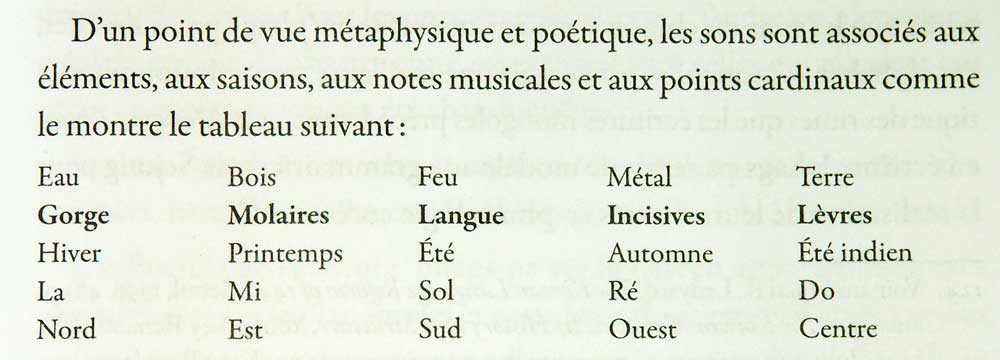
The cardinals are related to the elements, the sound-producing parts of
the body, the seasons and the music notes. |


Picture
at left: courtesy
Le
prisme des
langues by N. Tournadre, p. 93, L'Asiathčque, 2014
|
North = PÓŁNOC
East = WSCHÓD
South
= POŁUDNIE
West = ZACHÓD
|
|
Norte
Leste
Sul
Oeste
(Click on pic for enlarged view)
|

|
Nord
Est
Sud
Vest
NOTE:
This compass features a division in 6000
Mils (see explanations in Divisions).
|

This compass was made by IOR, see also Bézard |
North: Север
(sever)
East:
восток
(vostok)
South: юг
(yug) or летне
(lietne) i.e. summer on old maps (click
on img. at r.
for an enlarged view)
West:
запад
(zapad)
(Compare
with Bulgarian
and Serbo-Croatian).
|
  Note:
Sometimes the
German abbreviations N-S /
W-O are used instead of С-Ю /
З-В. This tradition dates back to Peter the Great who created
the
Russian Navy. The older ship compasses featured these markings and were
even marked with a Z (for Zuid in Dutch) instead of S.
Example:
see "AZIMUT". Note:
Sometimes the
German abbreviations N-S /
W-O are used instead of С-Ю /
З-В. This tradition dates back to Peter the Great who created
the
Russian Navy. The older ship compasses featured these markings and were
even marked with a Z (for Zuid in Dutch) instead of S.
Example:
see "AZIMUT".
|
 North:
sever North:
sever
East: istok
South: jug
West: zapad
Left col.: latin letters,
Right col.: cyrillic letters |
 
|
North: norden
East: öster
South: söder
West: väster
NOTE:
This compass features a division in 6300
Mils. (see explanations in SILVA
and Divisions).
|

|
In Turkey, three different systems were used. During the
Ottoman era, the Arabic
alphabet (see
below and
pics at
right)
was used. After the Kemalist revolution the latin alphabet was
introduced and some words of the language replaced by new ones. The
cardinals points were among the latter (see 2nd row:
Bézard Compass).
Depending on the transcription some letters may differ:

(Source:
Wikipedia - click on image for enlarged view)
|

The cardinal points written in the Arabic
alphabet in
old Turkish on an antique compass. North is marked by a fleur de lis
(heraldic lily) with the
equivalent names in English.
(Compare with ARABIC above)
NOTE: In the Ottoman
empire the cardinal points were also designated by colours.
- kara = black for north. Hence Karadeniz for the
Black Sea located north of Turkey
- ak = white for south. Hence Akdeniz for the Mediterranean
- kızıl = red for west (setting sun?)
- yeşil = green or sari = yellow for east (source WIkipedia).
|

Picture
by courtesy of
Kornelia Takacs |
English / Old Turkish / New Turk.
North = Şimal (Ş) / Kuzey
(K)
East = Şark (SK)
/ Doğu (D)
South = Cenup (C)
/ Güney (G)
West = Garp (GP)
/ Batý (B)
|

The cardinals in old Turkish but in the latin alphabet on a Bézard
compass dated approx. 1930
At right: modern Turkish
|

|